


Ultrasonic plastic assembly technology is widely used in the connection of thermoplastics. The joints produced by it are not only strong and durable, but also beautiful in appearance. This technology covers four major categories, among which ultrasonic welding is the focus of research. Ultrasonic welding uses high-frequency ultrasonic energy (15-50 khz) to generate low-amplitude (1-100μm) mechanical vibrations. This vibration acts on the joints of the components, melting the thermoplastic material through frictional heat generation, and then forming a weld. Its welding speed is extremely fast, usually between 0.1 seconds and 1.0 seconds.
During the ultrasonic welding process, sinusoidal standing waves are generated in thermoplastics. Due to intermolecular friction, part of the energy is converted into heat energy, which increases the temperature of the material. Another part of the energy is concentrated and transferred to the joint, which is further locally heated by boundary friction. Therefore, the transmission path of ultrasonic energy and the melting behavior of the material are jointly affected by the geometry of the part and the ultrasonic absorption characteristics of the material.
When the vibration source is close to the weld joint, the material has less energy absorption loss. If the distance from the vibration source to the joint is less than 6.4 mm, the process is called near-field welding, which is suitable for crystalline materials with high energy absorption and low stiffness materials. If the distance is greater than 6.4 mm, it is called far-field welding, which is suitable for amorphous materials with low energy absorption and high stiffness materials.
Due to the "uneven" characteristics of the joint surface, it is easy to generate high temperature and high friction, which is conducive to the accumulation of ultrasonic energy. In many ultrasonic welding applications, a triangular protrusion is designed on the surface of the upper part, called the energy guide rib, which guides the vibration energy to concentrate at the joint.
During the ultrasonic welding process, the vibration energy acts vertically on the joint surface, and the tip of the energy guide rib contacts the welded part under pressure. Due to frictional heat generation, a large amount of heat is generated at the tip, causing the energy guide rib to begin to melt. The entire welding process can be divided into four stages. First, the top of the energy guide rib begins to melt, and the melting rate gradually increases. As the gap on both sides of the joint decreases, the molten energy guide rib will fully spread and contact the part below, and the melting rate will decrease at this time. Secondly, the upper and lower parts are in surface contact, and the melting area is further expanded. Then, it enters the steady-state melting stage, at which time a molten layer of a certain thickness is formed, accompanied by a stable temperature field. When the preset welding energy, time or other control conditions are reached, the ultrasonic vibration will stop. Finally, the pressure is maintained, the excess melt will be squeezed out of the weld, and the parts are connected by molecular bonds and gradually cooled.
 Advantages and Disadvantages of Ultrasonic Welding
As a plastic joining technology widely used in the industrial field, ultrasonic welding stands out for its fast, economical, easy automation integration and suitability for mass production. Its weld stability is excellent, the strength is also high, and the welding time is shorter than other processes. In addition, this technology does not require a complex ventilation system to remove smoke or a cooling system to remove excess heat, with high energy utilization, higher production efficiency and lower cost. The mold design is relatively simple and the mold change speed is fast, thereby improving the utilization rate and versatility of the equipment. It is worth mentioning that since no other auxiliary welding materials are introduced into the weld, the weld remains clean and free of impurities, does not affect the biocompatibility of the equipment, and is very suitable for use in the healthcare industry with higher requirements for cleanliness.
However, ultrasonic welding also faces some limitations. For products with a size of more than 250mmX300mm, the design of the welding head becomes difficult, and it is often necessary to use multiple welding heads for synchronous welding or a single welding head for multiple welding to complete. In addition, the results of ultrasonic welding are closely related to factors such as weld structure design, injection molded part dimensional error and deformation. At the same time, ultrasonic vibrations may cause damage to sensitive electronic components, although such risks can be reduced by increasing the frequency and reducing the amplitude.
Application Fields
Ultrasonic welding is widely used in many industries. For example, in the automotive industry, it is used to connect components such as headlights, dashboards, buttons and switches; in the electronics and electrical industries, this technology is also often used to connect components such as switches, sensors and actuators; in addition, ultrasonic welding is also indispensable in the manufacturing process of products such as filters, catheters, medical clothing and masks in the medical field. At the same time, the production of products such as blister bags, bags, storage containers and nozzles in the packaging industry also benefits from the efficiency and convenience of ultrasonic welding.
The coffee cup is made of PS material, and its weld design cleverly combines the groove and the energy-guiding rib, which not only ensures the stability of the connection, but also improves the efficiency of production.
The electronic switch is made of ABS plastic and refined by ultrasonic riveting.
The reflector is made of a mixed material of ABS and PC, and combines the welding process of steps and energy-guiding ribs to create a unique structural design.

The electronic lamp uses a composite material of ABS and PMMA, combined with the exquisite welding process of plane and energy-guiding ribs, presenting a unique design style.
The electrical connector combines the solid materials of ABS and metal, and ensures the stability and durability of its connection through precise ultrasonic riveting.

The medical bottle is made of PC material and cleverly uses the fusion design of plane and energy-guiding rib welds.
The fuel filter bottle is made of nylon 6-6, and its design cleverly combines the dual processes of shear seams and welds.
The assembly of the filter membrane and the sound-absorbing cotton uses a composite material of nylon doped with 30% glass fiber, and is finely assembled through a piercing welding process.
The electrical box uses a composite material of PS and copper nuts, and is finely made through ultrasonic inlay technology.
The rotor uses PS material and combines the clever design of the plane and energy-conducting rib welds.
Polymer structure
The molecular structure of amorphous plastics is randomly distributed and lacks a fixed arrangement direction. Its characteristic is that it gradually softens with the temperature range. When this type of material reaches the glass transition temperature, it gradually softens and eventually enters a liquid molten state. The process of the material from liquid to solidification is gradual. Amorphous plastics can effectively transmit ultrasonic vibrations, and because of their wide softening temperature range, they are easier to weld and achieve sealing.
On the other hand, the molecular structure of semi-crystalline plastics is orderly arranged. High heat is key to breaking up the orderly arrangement. These plastics have sharp melting points, and once the temperature drops slightly, the liquid state will solidify quickly. Therefore, the melt flowing out of the hot melt area will solidify quickly. When solid, the molecular behavior of semi-crystalline materials is like a spring, absorbing most of the ultrasonic vibrations instead of transmitting them to the joint area. Therefore, for semi-crystalline plastics, a high-amplitude output welding head is required to generate enough heat.
 Tg glass transition temperature and Tm melting temperature
When discussing polymer structure, we mentioned two important temperature concepts: Tg glass transition temperature and Tm melting temperature. Tg is the temperature at which the material changes from a glassy state to a highly elastic state, at which time the material begins to gradually soften. Tm is the temperature required for the material to completely melt into a liquid. These two temperature characteristics are crucial to understanding the processing and performance of polymer materials.
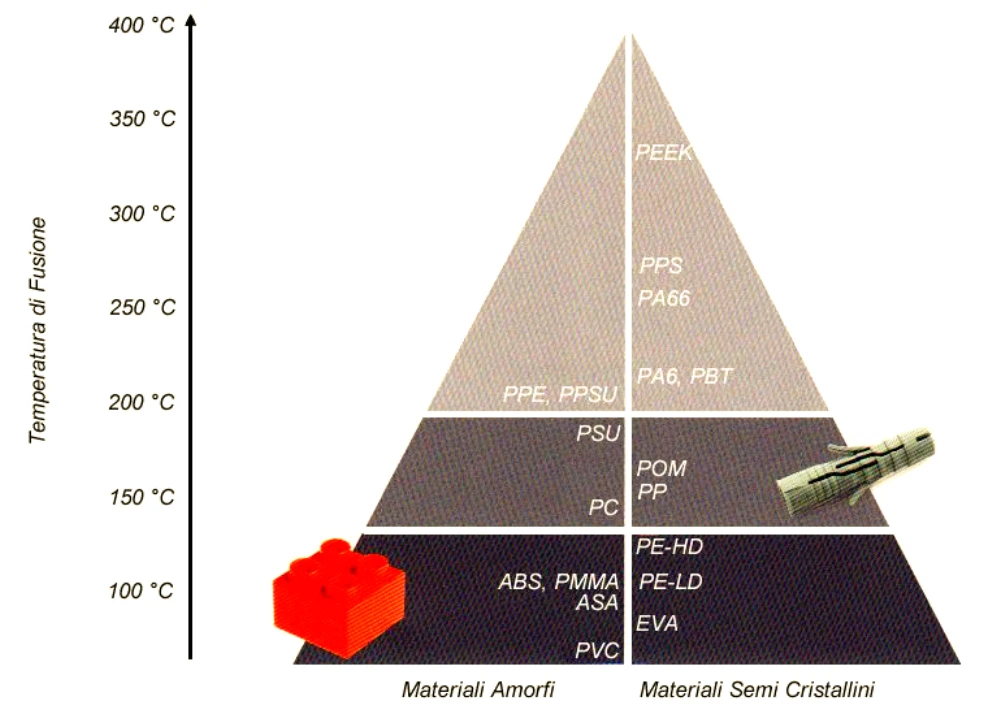
The left side of the figure above shows an amorphous plastic, while the right side shows a semi-crystalline plastic. In thermoplastics, fillers such as glass fiber, talc, and minerals can enhance or inhibit the effect of ultrasonic welding. Certain materials, such as calcium carbonate, kaolin, talc, alumina, as well as organic fibers, silica, glass balls, calcium metasilicate (wollastonite) and mica, can increase the hardness of the resin. Studies have shown that when the filler content reaches 20%, it can effectively enhance the transmission efficiency of ultrasonic vibrations in the material, especially for semi-crystalline materials. However, when the filler content exceeds 35%, the reliability of the seal may be affected due to insufficient resin content at the weld. When the filler content reaches 40%, the glass fibers will gather at the joint position, resulting in insufficient resin content at the weld, which in turn affects the weld strength. In addition, during the injection molding process, long glass fibers tend to accumulate on the energy-guiding ribs. An effective solution is to use short glass fibers instead of long glass fibers.
In addition, when the filler content exceeds 10%, abrasive particles in the material may cause wear of the welding head. Therefore, it is recommended to use a carbide steel welding head or a titanium alloy welding head covered with tungsten carbide coating. At the same time, it may be necessary to select a higher power ultrasonic device to ensure that sufficient heat is generated at the joint.
On the other hand, while additives can improve the overall performance or injection molding characteristics of the material, they often have an inhibitory effect on ultrasonic welding. Typical additives include lubricants, plasticizers, impact modifiers, flame retardants, colorants, foaming agents, and reground resins. For example, lubricants such as wax, zinc stearate, stearic acid, and fatty acid esters reduce the friction coefficient between polymer molecules, thereby reducing heat generation. However, this effect is usually smaller at the joint because the lubricant concentration is low and evenly dispersed. On the other hand, plasticizers such as high-temperature organic liquids or low-temperature melting solids increase the softness of the material and reduce the stiffness, but they reduce the attraction between the internal molecules of the polymer and interfere with the transmission of vibration energy. In particular, highly plasticized materials such as vinyl are very unsuitable as transmission materials for ultrasonic vibrations. In addition, plasticizers as internal additives may migrate to the surface of the plastic over time, further affecting the effect of ultrasonic welding. Similarly, impact modifiers such as rubber also reduce the material's ability to transmit ultrasonic vibrations, requiring a larger amplitude to melt the plastic.
Flame retardants, inorganic oxides or halogenated organic elements (such as aluminum, antimony, boron, chlorine, bromine, sulfur, nitrogen or phosphorus) added to the material can effectively suppress the material's fire point or change its combustion characteristics. However, these ingredients often make the material unweldable, especially when the flame retardant accounts for 50% or more, which will significantly reduce the amount of weldable material. For such materials, high-power ultrasonic equipment and welding heads with large amplitudes are required, and the joint design is adjusted to increase the proportion of weldable material.
Most colorants, including pigments and dyes, do not hinder the transmission of ultrasonic vibrations. However, they may reduce the amount of weldable material in the joint area. In particular, when the content of titanium dioxide (TiO2) exceeds 5%, its lubricant effect will become apparent, which will have an inhibitory effect on ultrasonic welding. At the same time, carbon black will interfere with the propagation of ultrasonic energy in the material.
Foaming agents reduce the material's ability to transmit ultrasonic vibrations because their low density and large number of pores in the molecular structure prevent effective energy transmission.
When ground resin (regrind) is mixed into the material, its addition and volume need to be carefully evaluated and controlled to optimize the welding effect. In some cases, regrind may not be used at all and 100% virgin material is required.
In addition, while mold release agents such as zinc stearate, aluminum stearate, fluorocarbons and silicones can help to release injection molded parts, they may transfer to the joint surface and reduce the friction coefficient of the material, thereby reducing heat generation and inhibiting ultrasonic welding. At the same time, mold release agents may also cause chemical contamination to the resin and affect the formation of proper chemical bonds. Silicones, in particular, have the most significant impact. Therefore, when using mold release agents, it is necessary to carefully select the appropriate grade and take measures to prevent it from transferring to the surface of the part.
In addition, different grades of materials may have different melting temperatures and flow indexes, which can also affect the effect of ultrasonic welding. For example, cast grades of PMMA may be more difficult to weld than injection/extrusion grades due to their higher molecular weight and melting temperature. Therefore, in order to obtain the best welding effect, try to select materials of the same grade for welding, and ensure that the flow index of the two materials is similar and the melting temperature difference is within 22°C.
The moisture content of a material has a significant effect on its weld strength. Hydroscopic materials such as PBT, PC, PSU and nylon easily absorb moisture from the air. During the welding process, this absorbed moisture will boil at high temperatures, and the generated gas, if trapped in the weld, will form pores and degrade the plastic, thus affecting the aesthetics, strength and sealing of the weld. To avoid this, hydroscopic materials should be welded immediately after injection molding. If immediate welding is not possible, the dried parts should be stored in a dry PE bag or placed in an oven at 80°C for 3 hours before welding.
In addition, when welding different types of materials, special attention should be paid to the melting temperature and molecular structure of the two materials. The ideal welding condition is that the melting temperature difference of the two materials does not exceed 22°C and the molecular structure is similar. If the melting temperature difference is too large, the material with a lower melting point will melt and flow first, and will not provide enough heat to melt the material with a higher melting point. For example, when welding high-melting-point PMMA with low-melting-point PMMA, if the energy conductor is located on the high-melting-point PMMA, the low-melting-point material joint will melt and flow first, causing the energy conductor to soften, which in turn affects the welding strength.
In addition, material compatibility is also a key factor for successful welding. Only chemically compatible materials, that is, materials with similar molecular structures, can be welded. It is worth noting that material compatibility mainly exists between amorphous materials, such as ABS and PMMA, PC and PMMA, and PS and modified PPO. However, semi-crystalline plastics such as PP and PE, although they have similar physical properties, have different molecular structures and therefore do not have material compatibility and cannot be welded.


